
Last updated August 25, 2026
Free on-site gate assessment - hinges, posts, and your LiftMaster or Nice gate operator checked before anything is quoted
The assessment is free and the quote is the invoice.

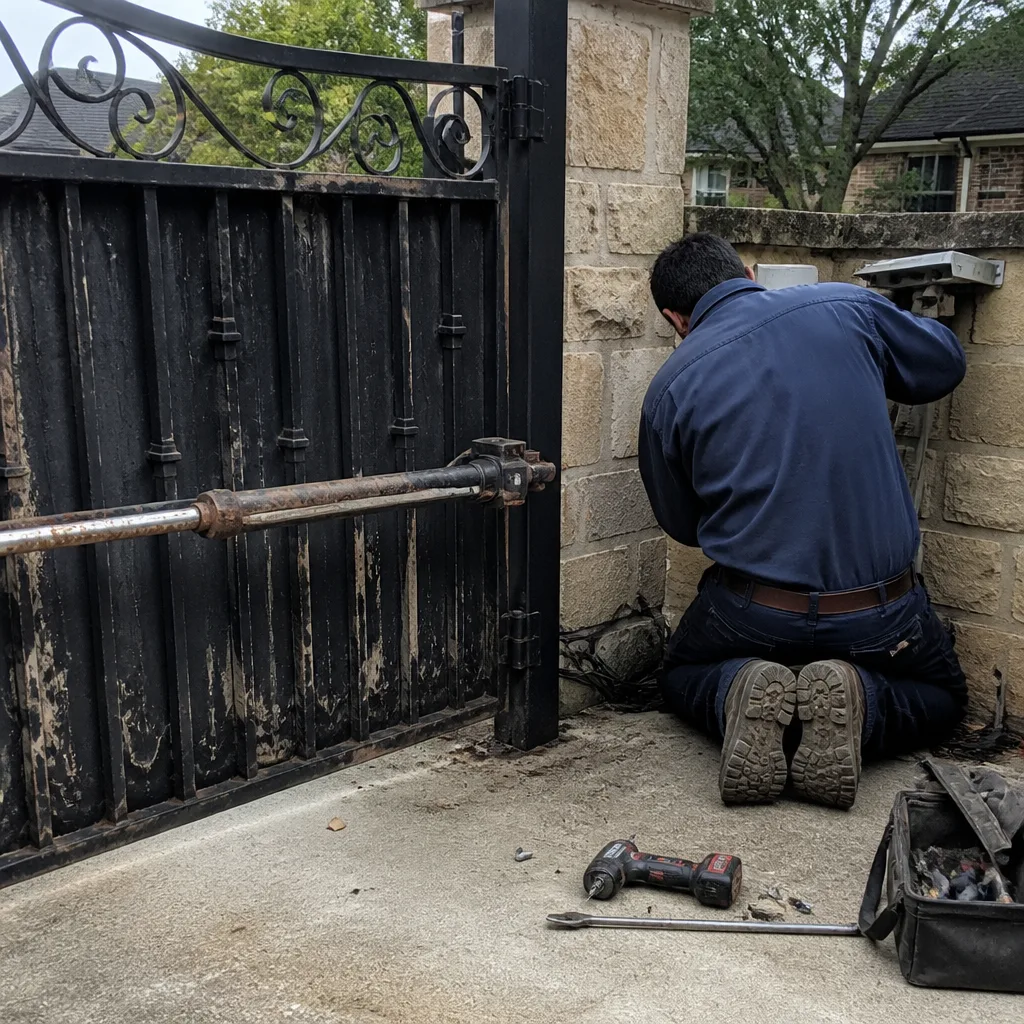 Before
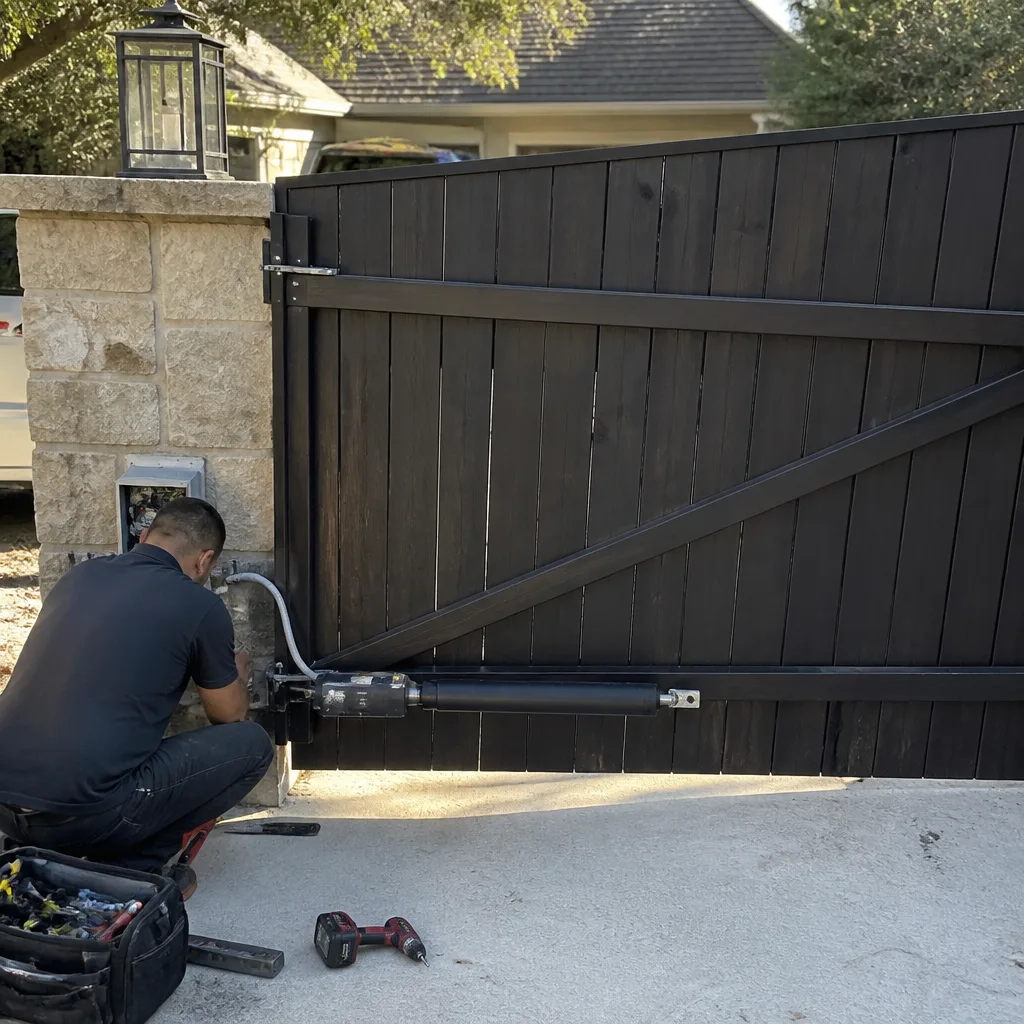 After
After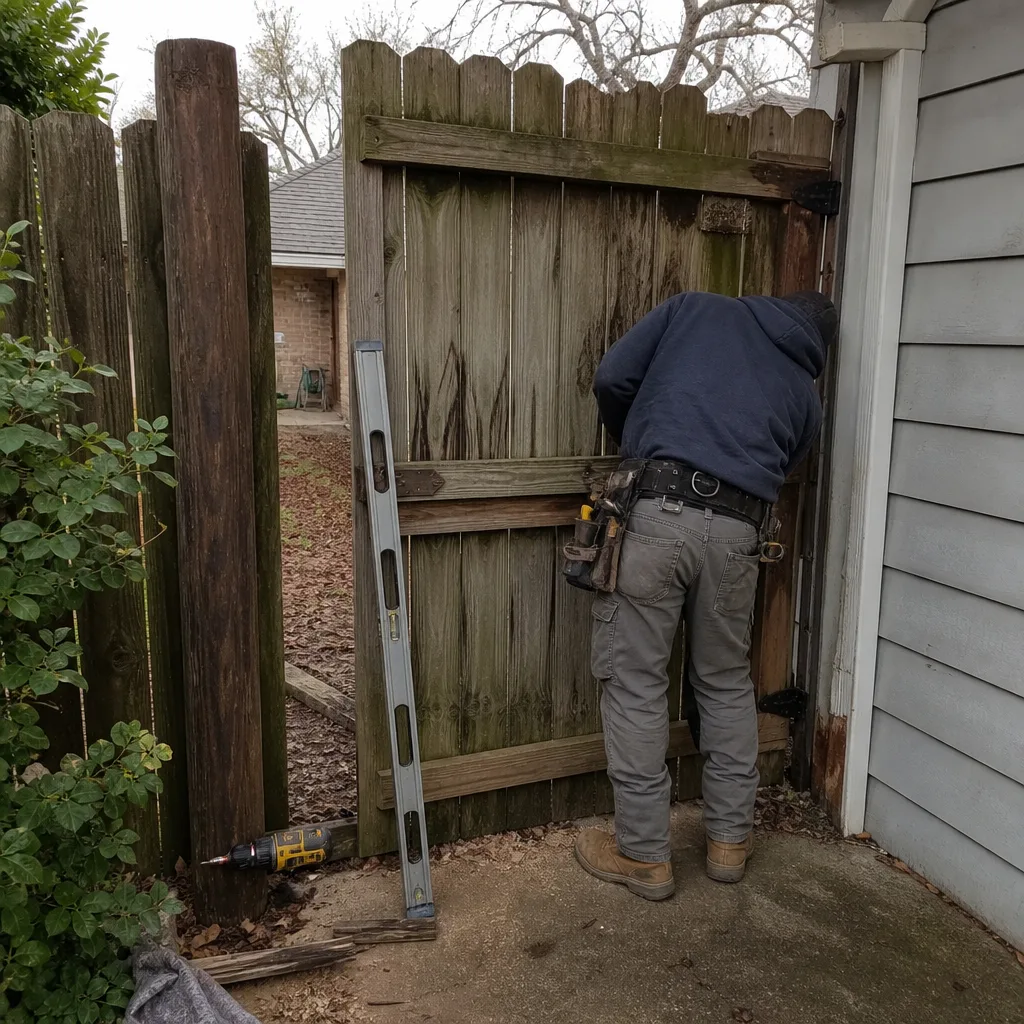 Before
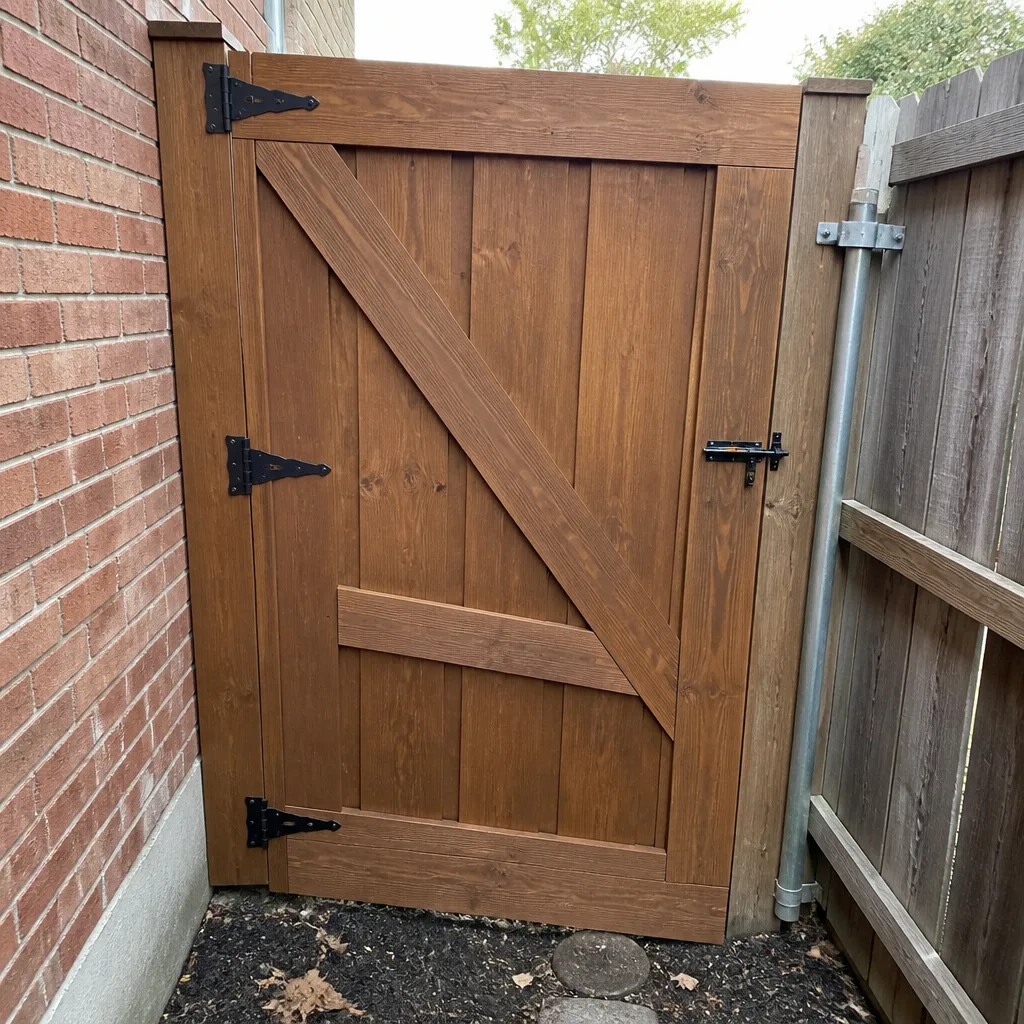 After
After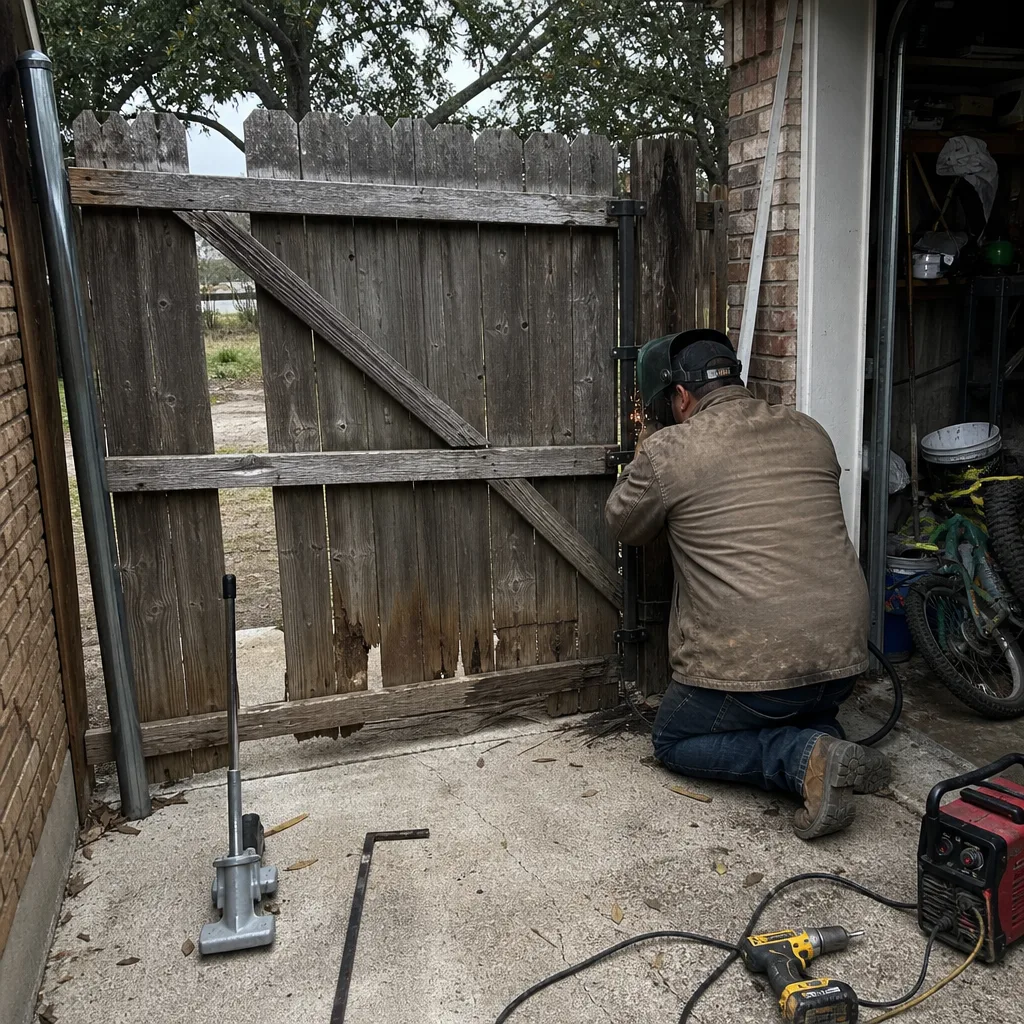 Before
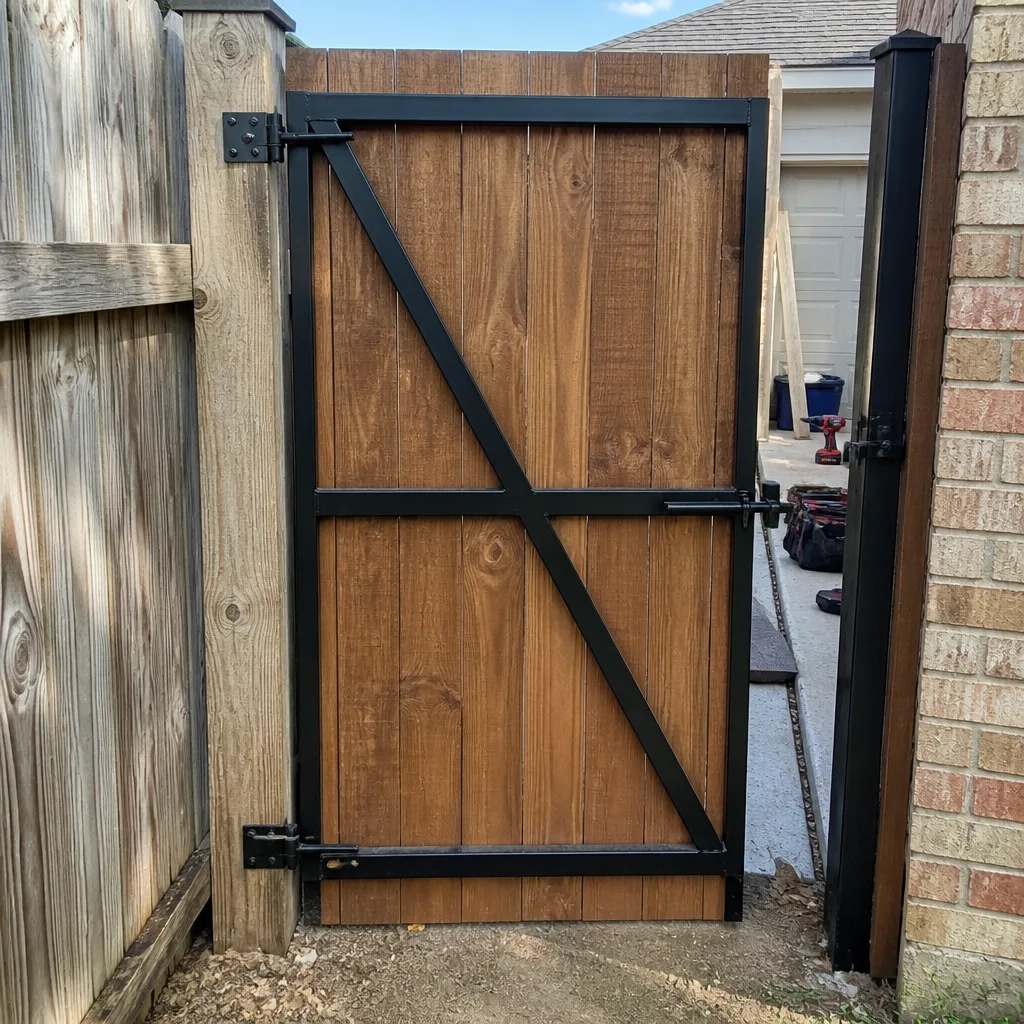 After
AfterDIY vs Professional Gate Repair: The Kennedale Homeowner’s Decision Guide
Here’s a truth most homeowners don’t hear until it’s too late: a gate is the only machine on your property that moves hundreds of pounds of steel several times a day, every day, in the open Texas weather, for years on end, and is expected to never fail. In Kennedale, where summer heat bakes the metal and spring thunderstorms soak the motors, that expectation gets tested harder than almost anywhere. This guide walks through exactly which gate repairs make sense to tackle yourself, which ones will cost you more money if you try, and how to tell the difference before you’re standing in the driveway at 6 a.m. with a gate that won’t open and a car stuck on the wrong side of it.
Quick Answer
Most cosmetic and hardware-level gate repairs on a manual gate, like tightening a sagging hinge or replacing a latch, are reasonable DIY projects for a Kennedale homeowner with basic tools and a free afternoon. Most automated gate problems, including anything involving the motor, circuit board, safety sensors, or high-tension springs, are not, and attempting them typically turns a $200 service call into an $800 repair. The line sits wherever the repair touches electricity, stored mechanical energy, or the weight-bearing structure of a moving gate. If you have to ask whether a job crosses that line, it probably already has.
Table of Contents
- Understanding the Two Types of Gates
- What’s Safe to Repair Yourself
- What Should Never Be a DIY Project
- The Real Cost of DIY vs Professional Repair
- How Kennedale’s Climate and Soil Affect Your Gate
- A Step-by-Step Approach to Any Gate Problem
- Common Mistakes to Avoid
- When to Call a Professional
- Frequently Asked Questions
- The Bottom Line
Understanding the Two Types of Gates
Before you can decide whether a repair is a weekend project or a phone call, you need to know which category your gate falls into. Kennedale homes tend to have one of two setups, and they fail in completely different ways.
A manual gate swings or slides by hand. It has hinges, a latch, maybe a drop rod, and a wheel or two if it slides. There’s no motor, no circuit board, no remote. This is the simpler machine, and most of its problems are mechanical: worn hinges, sagging posts, a latch that doesn’t line up anymore, a wheel that’s seized up. These are approachable repairs for a capable homeowner.
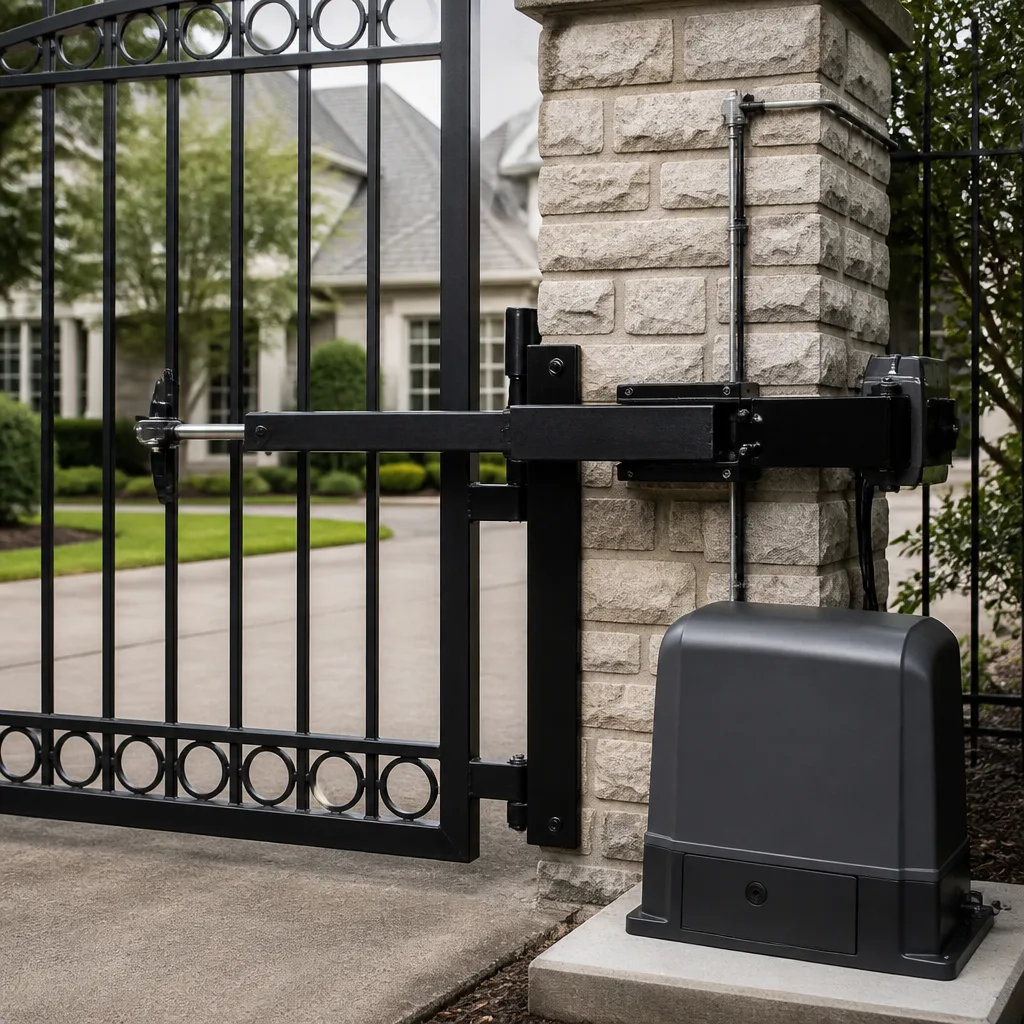
An automated gate is a different animal entirely. It has all of the above plus an operator (the motor unit that mounts near the hinge or slides the gate along a track), a control board inside that operator, safety sensors that keep the gate from closing on a car or a grandchild, a receiver for remotes and keypads, and limit switches that tell the gate where to stop. When one part of that system fails, it often stresses the other parts. A gate that’s hard to move because the hinges are shot will burn out a $600 operator motor in a season. An operator that’s slamming the gate open and closed because a limit switch drifted will crack welds on the frame. Automated gate repair is systems work, not parts swapping.
In our experience across Kennedale, Newman, Rendon, and the surrounding area, maybe 30 percent of the gates we service are manual. The other 70 percent are automated, and most of those are at least 15 years old, which matters because the operator manufacturers we work with, brands like LiftMaster and FAAC, build units that last 10 to 15 years under normal conditions. A gate that’s been cooking in Kennedale sun for two decades is on borrowed time no matter how well it was installed.
What’s Safe to Repair Yourself
If your gate is manual and the problem is mechanical, you can probably handle it. Here’s a straightforward list of repairs that fall into the reasonable DIY category for a homeowner who owns a socket set, a level, and a can of penetrating oil.
- Tightening sagging gate hinges. Over time, the bracket bolts that hold hinges to the post or the gate frame loosen up. Tightening them with a wrench, or replacing them with longer bolts if the holes are stripped, is a Saturday afternoon job. The gate should swing level when you’re done.
- Replacing a latch or a drop rod. Latches wear out. If yours is rusted through or the spring inside gave up, a replacement from a fence and gate supply house costs $15 to $40 and installs with two bolts.
- Cleaning and greasing manual gate rollers and wheels. Slide-gate wheels collect dirt and grass clippings. Pull them out, clean the axle, pack them with grease, and reinstall. This takes an hour and costs nothing.
- Tightening or replacing gate post caps. Post caps keep water out of hollow steel posts. If one’s missing, the post rusts from the inside. A new cap is under $10.
- Repainting surface rust on a steel gate. Kennedale’s humidity means surface rust shows up fast once paint chips. Wire-brush the area, hit it with a rust converter, prime it, and paint. This is maintenance, not repair, and it’s very much a homeowner’s job.
The common thread here: these are all jobs where the gate is not under tension, not under power, and not supporting its own weight while you work on it. You can see everything you’re touching. If something goes wrong, the worst case is the gate sits crooked until Monday, not that someone gets hurt.
What Should Never Be a DIY Project
This section is short because the list is short, but every item on it deserves respect. These are the jobs where we’ve seen capable people hurt or expensive equipment destroyed. We’ll be direct about it.
- Anything involving torsion springs on a gate. Some cantilever slide gates and a few swing-gate designs use high-tension springs to help the gate move. These springs are under thousands of pounds of stored force. If one lets go while you’re working on it, it will break bone or worse. Do not touch them. Call someone trained to handle them.
- Operator motor replacement or rebuild. The motor inside a gate operator, whether it’s a Mighty Mule on a residential driveway or a BFT on a commercial entrance, is not plug-and-play. It has to be matched to the gear ratio of the operator, wired to the control board correctly, and set up with the right torque limits. Get the torque wrong and the gate becomes a battering ram. Get the wiring wrong and you’re dealing with a live 120-volt circuit in a metal box.
- Control board or circuit board replacement. Board failures are common after lightning storms, which Kennedale gets plenty of. But a board is never the whole story. The board failed for a reason, often a short in a sensor wire or a motor drawing too many amps. If you swap the board without finding the underlying fault, you’ll be swapping another board in a month.
- Safety sensor or photo eye repair. Modern automated gates are required by code to have safety devices that stop and reverse the gate if something is in the path. If those sensors are misaligned, bypassed, or wired incorrectly, you have a gate that will close on whatever’s in its way. That’s not a repair compromise. That’s a safety hazard on your own family.
- Welding repairs on a gate frame. Cracks in a steel gate frame happen, especially at the corners where the weld heat has made the metal brittle over the years. A homeowner with a 110-volt flux-core welder from the big box store can make a bead that looks okay, but it’ll crack again because the joint wasn’t ground out, or the metal wasn’t pre-heated, or the penetration wasn’t there. A proper gate weld, done by someone who welds every day, lasts another decade. A bad weld fails in a season and takes the surrounding metal with it.
There’s a simple rule underneath all of this: if the repair involves electricity, stored force, or if the gate can move while you’re working on it, it’s a professional job. Not because a homeowner can’t learn, but because the cost of learning on your own gate is higher than the cost of a service call.
The Real Cost of DIY vs Professional Repair
Let’s talk numbers, because the math is not what most people expect. The DIY pitch is usually: “I can do it myself for the cost of parts.” That’s true for some jobs and completely false for others.
| Repair Type | Typical DIY Cost (Parts Only) | Typical Professional Cost in Kennedale | What You’re Actually Paying a Pro For |
|---|---|---|---|
| Tighten or replace gate hinges | $15-$50 | $150-$300 | Getting the gate level, not just tight |
| Replace a gate latch | $15-$40 | $125-$200 | Alignment so it actually latches |
| Replace a manual gate wheel | $20-$60 | $175-$325 | Matching the wheel to the track and weight |
| Replace an operator control board | $150-$400 (board only) | $450-$850 (board + diagnosis) | Finding and fixing what killed the first board |
| Replace a gate operator motor | $200-$500 (motor only) | $600-$1,200 (motor + setup) | Correct torque, limit, and safety setup |
| Gate frame crack welding | $100-$300 (welder rental + consumables) | $250-$600 | A weld that outlasts the original |
These ranges reflect what we see in Kennedale and the surrounding Tarrant County area. They are not quotes, but they’re realistic.
Here’s what the table doesn’t show: the cost of the second attempt. The homeowner who replaces a control board themselves and has it fail again in six weeks because a sensor wire was shorting has now spent $300 on parts, a weekend of time, and still needs the $500 professional repair. The homeowner who replaced a $400 operator motor and set the torque too high has now bent their gate frame, which was not broken before. That’s when a $700 repair becomes a $2,500 gate replacement.
Every professional repair from a reputable company comes with something the parts store doesn’t offer: a guarantee that the repair was the right one. At Ironworks Gate Co., every job, from a hinge replacement to a full automation rebuild, is protected by our written 90-Day Done Right Promise. If it’s not right, we come back and make it right. No paperwork, no arguing. That promise has real value, and it’s priced into the professional number.
How Kennedale’s Climate and Soil Affect Your Gate
Gates don’t fail in a vacuum. They fail in Kennedale, and that specific zip code matters more than most homeowners realize. Here’s what the local environment does to a gate over 10, 20, and 30 years.
Heat and UV exposure. Kennedale regularly sees 100-degree days through July and August. That heat does two things to a steel gate: it causes the metal to expand, which stresses welds and hinge points, and it bakes the plastic components inside gate operators, particularly the gears and the wire insulation. We regularly see operator gears in Kennedale that have gone brittle and stripped after 8 to 10 years, which matches what the manufacturers tell us about heat-degraded nylon parts. A gate in a shaded lot lasts years longer than the identical gate in full south-facing sun in a neighborhood like Interlochen or Summer Creek.
Clay soil and movement. The soil in this part of Tarrant County is heavy black clay. It swells when it rains and shrinks when it dries. Over a year, the ground under a gate post can rise and fall half an inch or more. That movement is why gate posts lean, why latches stop lining up, and why slide gates derail. We’ve seen gates in Kennedale where the post moved so far out of plumb that the gate was dragging on the driveway and the homeowners thought the motor was burned out. The motor was fine; the ground had moved the post.
Thunderstorm lightning. North Texas has some of the most active lightning in the country, and gate operators are vulnerable. A strike doesn’t have to hit the gate directly. A nearby strike induces a surge through the power line or the low-voltage sensor wires, and that surge kills control boards. We’ve worked on more lightning-damaged boards in Kennedale than for any other single cause. The homeowners who protect their gate with a proper surge protector have fewer lightning failures. Most gates don’t have one.
Wind and debris. March and April bring straight-line winds that stress swing gates, especially wide driveway gates that catch wind like a sail. A 20-foot gate in a 40-mph gust puts enormous load on the hinge posts and the operator. We see bent hinge brackets and sheared bolts after every storm season.
Understanding these local factors matters because it changes how you diagnose a problem. A sagging gate in Kennedale is usually not just a worn hinge; it’s a hinge that wore faster because the post it’s bolted to moved in the clay soil. Fix the hinge and you’ve bought a year. Fix the post base and the hinge together, and you’ve bought a decade. That’s the difference between parts replacement and repair.
A Step-by-Step Approach to Any Gate Problem
If you’re staring at a gate that won’t open, won’t close, or won’t stay where you put it, work through these steps in order. This is the same basic diagnostic process we follow on every service call, and it will help you decide whether you’re dealing with a simple fix or a professional repair.
- Identify exactly what the gate is doing wrong. Write it down or say it out loud. “It opens but won’t close.” “It closes but the motor keeps running.” “It only opens halfway.” “It makes a grinding noise.” “It won’t move at all.” The more specific the symptom, the easier the diagnosis. “The gate is broken” is not a symptom.
- Determine whether the problem is the gate or the operator. Disconnect the operator from the gate by pulling the manual release handle. Most operators on brands like LiftMaster and FAAC have a release that lets you push the gate by hand. If the gate swings or slides easily by hand, the mechanical gate is fine and the problem is in the operator or its wiring. If the gate is hard to move by hand, the operator may be fine and it’s fighting a mechanical problem like a dead hinge or a derailed wheel.
- Check the obvious electrical items. Is the operator plugged in and is the outlet live? Is the breaker tripped? Is there visible water intrusion in the operator housing? Are the remote batteries dead? Does the keypad have power? In Kennedale’s summer heat, keypad screens fade and remotes die faster than in cooler climates.
- Look for sensor obstruction or misalignment. If the gate won’t close but will open, and it reverses or refuses to move when you press close, check the photo eyes near the bottom of the gate opening. Spiders build nests in them, weeds grow in front of them, and the summer heat warps the plastic brackets until the eyes don’t line up. Clean them, straighten them, and try again.
- Listen and look at the operator when it tries to move. A humming sound with no movement usually means a stripped gear or a failed capacitor. A clicking sound with no movement often means a stuck relay or a board that’s not sending power. Visible scorch marks or a burnt smell inside the operator housing means shorted components. These are all professional repair signals.
- Make the call on DIY vs professional. If your diagnosis points to a mechanical fix on a manual gate, and you’re comfortable with the tools, proceed with the repair. If your diagnosis points into the operator, the board, the wiring, or any spring under tension, stop diagnosing and make a phone call.
This process takes 15 minutes. It’s the most valuable 15 minutes you can spend on a broken gate, because it tells you whether you’re dealing with a $20 fix or a $500 repair, and it prevents the “replace parts until something works” approach that drains wallets.
Common Mistakes to Avoid
We’ve been repairing gates in Kennedale for years, and these are the mistakes we see homeowners make most often, year after year. Some are expensive. A few are dangerous. All of them are avoidable.
- Adjusting the torque or force settings on an operator without knowing the manufacturer’s spec. Turning up the force so the gate “pushes through” a bind is the most direct way to bend a gate frame or burn out a motor. The force setting is a safety feature, not a convenience feature.
- Replacing a control board without replacing the failed component that killed it. Boards rarely die of old age by themselves. Lightning, a shorted wire, a bad capacitor, or a motor drawing too many amps kills them. Swap the board without fixing the cause and you’ll be swapping it again.
- Welding on a gate without disconnecting the operator and control board. Welding current travels. We’ve seen homeowners weld a hinge on a gate and fry the control board in the operator, because they left the operator wired up. That’s a $300 board on top of a $100 weld job.
- Using regular hardware store hinges on a heavy driveway gate. Big-box gate hinges are built for a 60-pound garden gate. A 400-pound steel driveway gate will destroy them in a year. Heavy gates need heavy hinges with grease fittings, and they need to be welded or through-bolted, not lag-screwed into thin wall tubing.
- Ignoring a gate that runs slowly or noisily. Gates don’t heal. A gate that’s getting slower or noisier is telling you that something is wearing out. Ignoring it means a $50 hinge problem becomes a $700 operator replacement. In Kennedale’s clay soil, a gate that’s started dragging usually means a post is moving, and the sooner you catch it, the cheaper the fix.
- Skipping the surge protector. North Texas lightning is not a rare event. A $60 surge protector on the operator power line is the cheapest insurance a gate owner can buy. We see the difference in our service calls every storm season.
- Assuming a new operator will fix a gate that’s been sagging for years. The operator doesn’t fix the hinge. The operator doesn’t fix the post. It just pushes harder against the same resistance until something gives, and what gives is usually the operator’s gear train or the gate’s frame.
When to Call a Professional
You should call a gate repair professional when the problem involves the operator, the control board, the wiring, the safety sensors, any spring under tension, or any weld repair on a gate frame. You should also call if your manual gate is sagging because a post has moved, because that means the post base needs to be dug out, re-set, and re-concreted, which is a bigger job than it looks. And you should call if you’ve already tried a fix and it didn’t hold. A repair that failed usually means the underlying problem wasn’t addressed, and the second attempt needs a more experienced eye. Ironworks Gate Co. offers free estimates in Kennedale, call (817) 286-7391 and we’ll tell you straight whether you need a service call or whether you can handle it yourself.
Frequently Asked Questions
Most professional gate repairs in Kennedale range from $150 for a simple hinge or latch fix to $1,200 for a full operator motor replacement. The most common service calls we make, operator board replacements and sensor repairs, typically land between $450 and $850. Every job is quoted and agreed before any work starts, so there’s no surprise on the bill. Call (817) 286-7391 for an exact quote, estimates are free.
Most homeowners should not attempt to repair the motor, board, or wiring inside an automatic gate opener. These components carry wall voltage, the gate itself is heavy enough to cause serious injury, and the safety systems that protect your family can be accidentally bypassed by an untrained repair. What a homeowner can do is check power, swap remote batteries, clear sensor obstacles, and keep the track and rollers clean. Leave the internals to someone who works on them every day.
Kennedale’s black clay soil moves with every rain and every dry spell, which shifts gate posts and throws off alignment. The summer heat bakes operator gears and electronics. Spring thunderstorms bring lightning that takes out control boards. These three local factors combine to shorten the life of gate components compared to areas with sandier soil and milder weather, and they mean a Kennedale gate needs more regular maintenance to stay reliable.
Most gate repairs in Kennedale are completed in a single visit, typically one to three hours on site. Board replacements, sensor repairs, hinge rebuilds, and most operator swaps are same-visit jobs. Full post replacements or major welding work can take longer, but those are the exception, not the rule. We stock parts for the brands we service, including LiftMaster, FAAC, and Mighty Mule, so most repairs don’t wait on a parts order.
We work on nine major gate automation brands, including LiftMaster, FAAC, BFT, Linear, Viking, Ghost Controls, DoorKing, Elite, and Mighty Mule. Whatever operator is on your driveway, the odds are good that we’re trained and equipped to service it, and that we have the common failure parts for it on the truck.
Yes. We’ve offered a standing 5% discount for seniors and veterans on every service call for years. It applies automatically when you mention it, and it stacks with our other standing offers, including $50 off any repair over $250 and the $89 seasonal tune-up. We believe the people who built Kennedale deserve a square deal on the gate that protects their home.
The Bottom Line
A gate is a machine, and like any machine, it has jobs you can do yourself and jobs you shouldn’t. Tighten the hinge, replace the latch, clean the rollers, paint the rust. But when the motor won’t run, the board is dead, the sensors won’t align, or the springs are involved, call a professional before the repair costs more than the gate is worth. In Kennedale’s heat, soil, and storm season, the margin for error is thinner than it looks. The right repair, done once, backed in writing, is the cheapest repair there is. Whether you do it yourself or call us, the goal is the same: a gate that opens and closes like it should, every time, for years to come.
Written by Victor Salinas, Owner at Ironworks Gate Co., serving Kennedale since 2013.