
Last updated August 25, 2026
Free on-site gate assessment - hinges, posts, and your LiftMaster or Nice gate operator checked before anything is quoted
The assessment is free and the quote is the invoice.

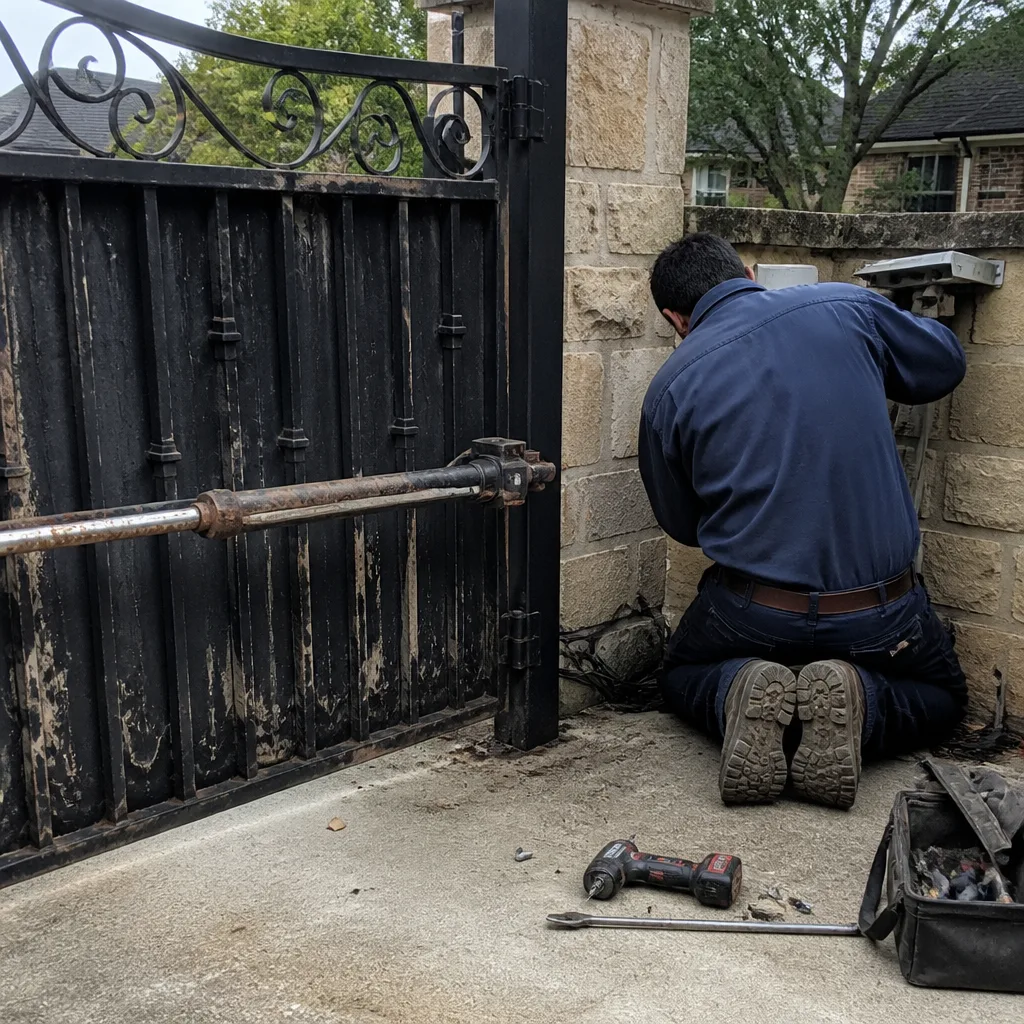 Before
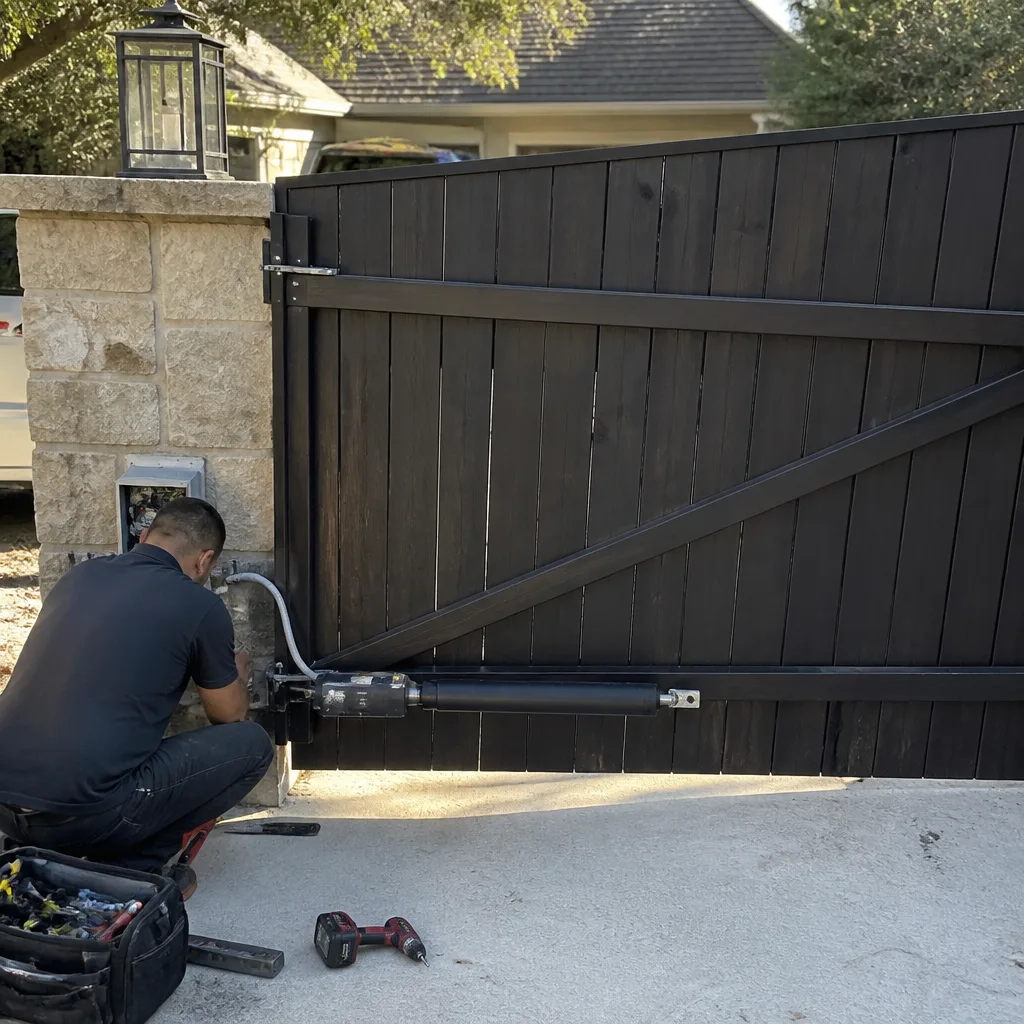 After
After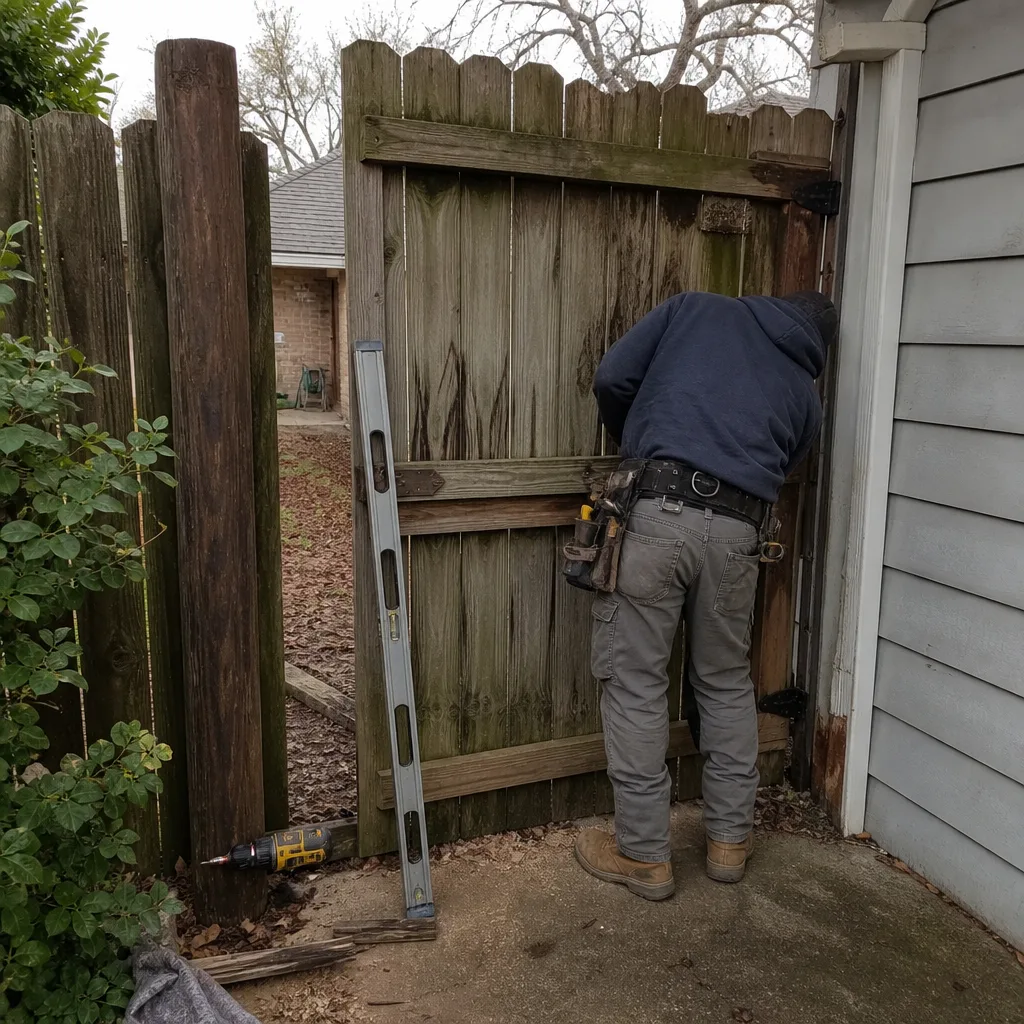 Before
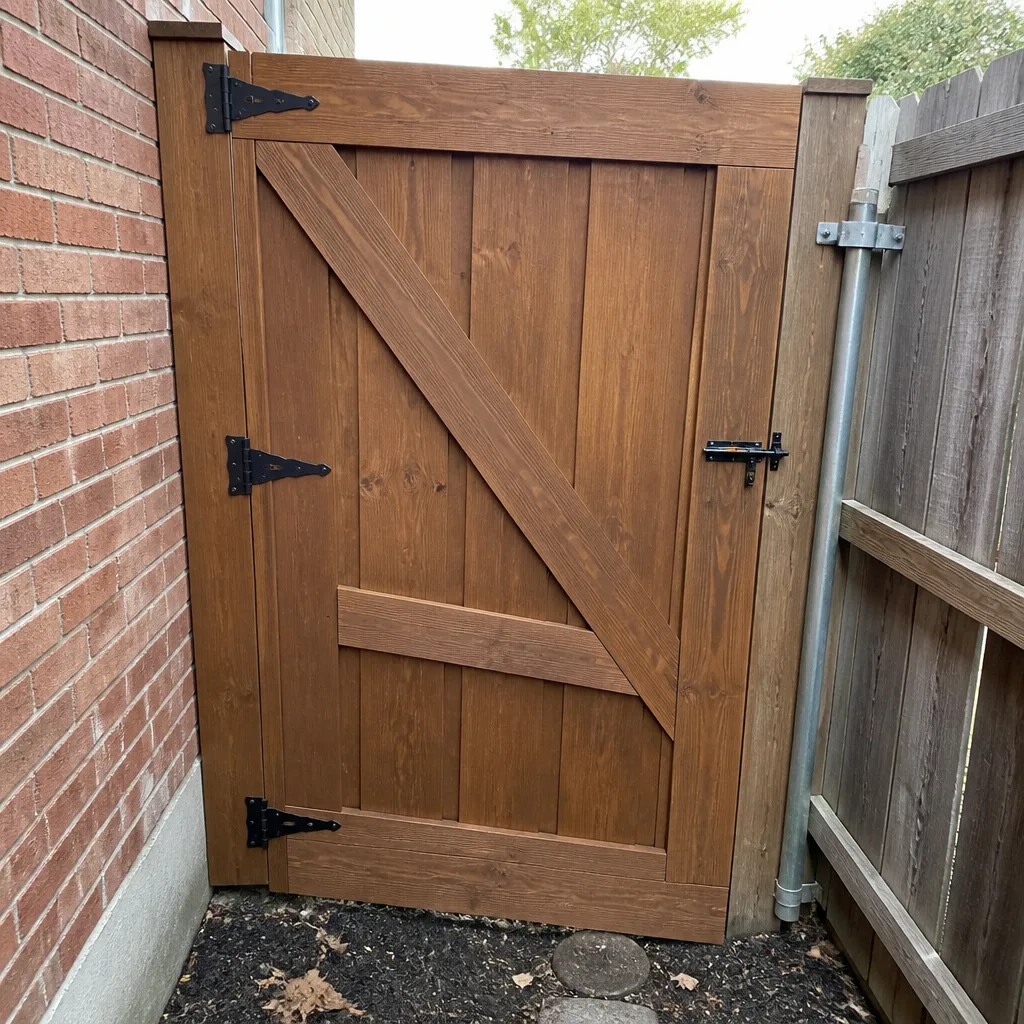 After
After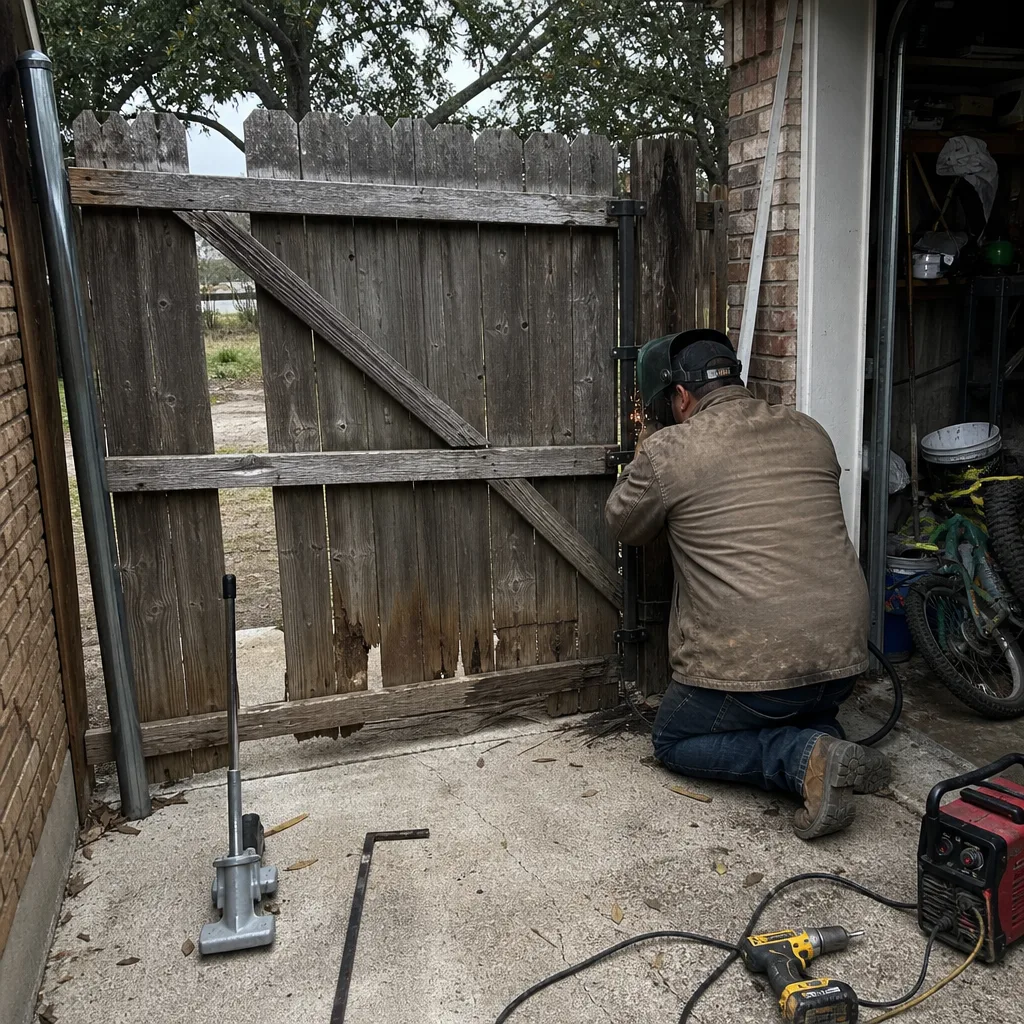 Before
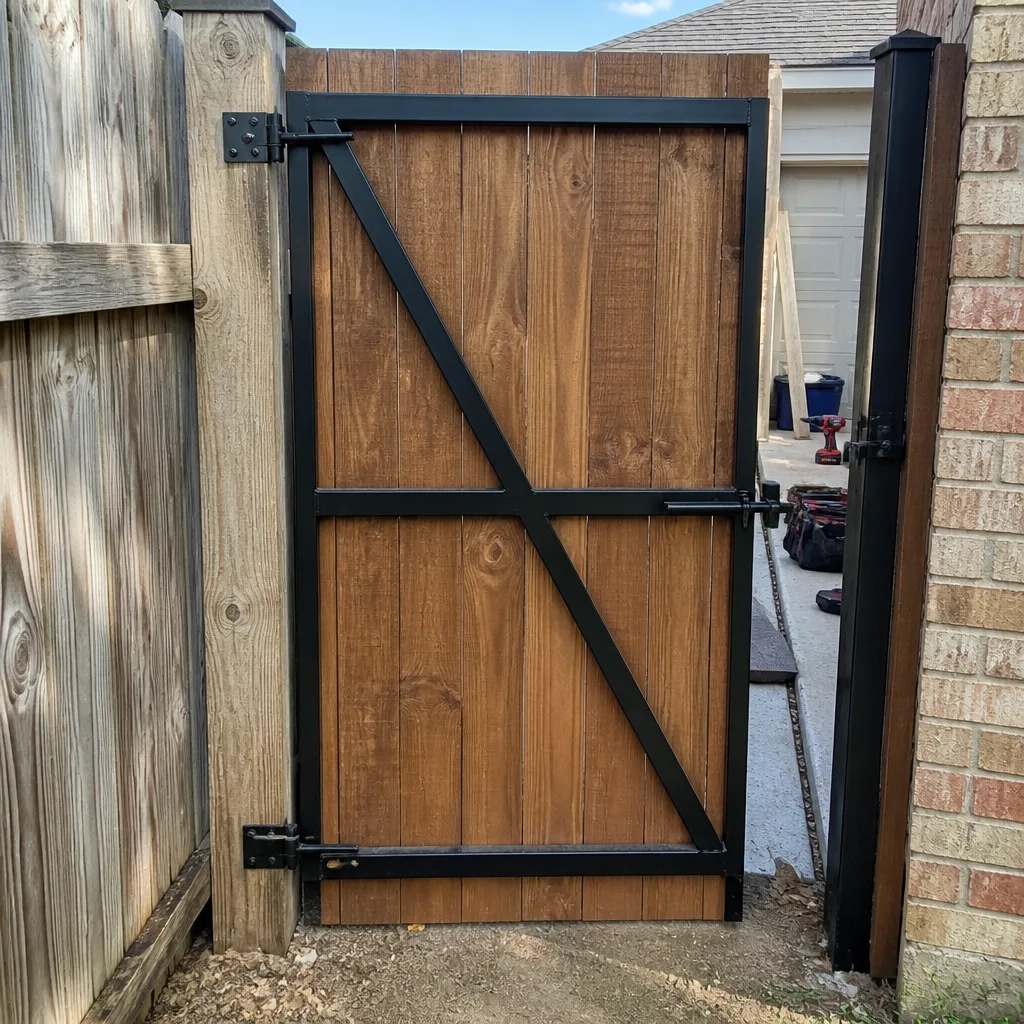 After
AfterGate Repair Warning Signs: A Kennedale Homeowner’s Reference Guide
Most gate failures in Kennedale don’t happen all at once. A driveway gate almost always announces its decline weeks or months before it quits, and the signs are easy to miss if you’re not looking for them. We’ve spent over four decades watching Texas gates age in exactly this way, and the pattern is consistent. This guide walks you through the specific warning signs we’ve learned to recognize early, what each one means for the health of the gate, and when a small fix can prevent a much larger repair bill. If you live in Kennedale and own a gate, this reference will help you read what the metal and the motor are trying to tell you.
Quick Answer
Gate repair warning signs fall into three clear groups: mechanical wear (sagging, sticking, grinding), electrical decline (slow response, intermittent operation, opener failing to respond), and structural fatigue (rust at joints, leaning posts, cracked welds). Any one of these symptoms warrants attention within weeks, not months, and most can be addressed with same-visit repairs before they become total replacements. A gate that hesitates, sticks, or groans is already telling you the next chapter, and that chapter is always more expensive than the one you’re in today.
Table of Contents
- How a Gate Wears in Kennedale: Climate, Soil, and Time
- Mechanical Warning Signs: Sag, Stick, Grind, and Bind
- Electrical Warning Signs: The Opener Is Trying to Tell You Something
- Structural Warning Signs: Rust, Weld Fatigue, and Leaning Posts
- Safety Device Failures: Photo Eyes, Edges, and Auto-Reverse
- What Each Repair Should Cost in the Kennedale Market
- Why a Written Guarantee Matters More on Gates Than Anywhere Else
How a Gate Wears in Kennedale: Climate, Soil, and Time
Kennedale sits in North Texas clay country, and that fact alone shapes how gates fail here more than almost any other factor. The soil expands when it rains and contracts through long dry stretches, shifting concrete post footings a fraction of an inch at a time. Over twenty years, those fractions add up, and the gate that once swung level starts to bind against its own latch. We see this specific failure mode more than any other in Kennedale, and it’s one reason why a gate that worked fine in May can start sticking by August.
Heat plays a role too. North Texas summers put real strain on opener electronics, control boards, and battery backups. Capacitors age faster in heat, solder joints expand and contract, and motors that run hot every afternoon for months at a time lose torque faster than the same motor would in a milder climate. If your gate opener is more than ten years old and has spent every summer facing full afternoon sun, its service life is already shorter than the manufacturer’s paper rating. None of this means gates are unreliable in Kennedale. It means the maintenance calendar matters here in a way it doesn’t in other regions.
There’s a third factor: time itself. Most gates in the Kennedale area are original to homes built between 1970 and 2005, which means many are now entering their third decade of service. That’s not ancient for a well-built steel gate, but it is old enough that hinges, bushings, and welds have begun to wear in predictable patterns. The right way to think about gate ownership in this climate is not “if it will need something” but “when it will need something.” The signs below help you answer that question early.
Mechanical Warning Signs: Sag, Stick, Grind, and Bind
Mechanical wear is the easiest category to notice because you can hear it and feel it without touching anything electronic. This is also where most deferred maintenance begins, because a gate that still opens is a gate most homeowners assume is fine. The gate is not fine. Here is what each symptom means and what tends to happen next if it’s ignored.
Sagging that you can see from the driver’s seat
Step back about ten feet and look at the top rail of your gate against the horizon. If the latch end sits visibly lower than the hinge end, you’re looking at hinge wear, post settling, or frame fatigue. A sag of even an inch changes how the gate closes, how evenly the weight loads on the hinges, and how hard the opener works on every cycle. In Kennedale, where clay soil shifts posts seasonally, sag is usually a combination of two problems: a hinge pin that has worn oval, and a post that has moved in the ground. Repairing one without checking the other fixes the symptom for a few months, not the gate.
Sticking or dragging at one point in the travel
A gate that opens smoothly for most of its arc, then hesitates or drags at a specific point, has a localized problem. Usually that’s a hinge lubrication failure, a bent section, or a wheel that has stopped rolling and started sliding on its track. When a gate hangs up mid-travel, the opener’s motor draws significantly more current to push through the resistance. That extra current produces heat, and heat is the slow killer of opener motors. Every cycle through the bind point shortens the motor’s life. This is a repair that costs far less than a replacement opener.
Grinding, screeching, or a rhythmic clunk
Hinges speak plainly. A screech means metal is riding on metal with no lubricant between them. A grind means something is misaligned enough that surfaces are cutting into each other rather than sliding. A rhythmic clunk that repeats with each revolution of a wheel or each pass of a chain link means a component is loose or worn enough to catch on every rotation. These sounds are not personality. They’re diagnostics, and they translate to specific, fixable defects. The longer the sound continues, the more material is being removed from the surfaces that make it.
Vibration or wobble during travel
Steel gate frames are rigid. If the leading edge of your gate shudders or oscillates as it moves, the frame has lost integrity somewhere: a cracked weld, a loose cross-member, a failed gusset, or a hinge bracket that has begun tearing away from the post. The gate still opens, which means this gets ignored for months. But the crack that causes today’s wobble is the same crack that, once propagated, turns a complete gate rebuild from a $400 repair into a $2,400 replacement. Vibration is the loudest warning sign most homeowners never act on.
In our experience across Kennedale, mechanical symptoms like these respond well to early intervention. Most hinge, wheel, and alignment issues are single-visit repairs. The critical variable is whether the underlying cause, often a shifted post, is addressed at the same time.
Electrical Warning Signs: The Opener Is Trying to Tell You Something
Most homeowners think of the opener as a black box that either works or doesn’t. In reality, openers degrade progressively, and they telegraph their decline through behavior changes that are easy to observe once you know what to look for. We’re trained on nine opener brands, including Ironworks Gate Co. home favorites like LiftMaster and FAAC, and the failure patterns diverge by brand but share common warning signs.
Slower response after the remote is pressed
A healthy gate opener begins moving within a second or two of signal receipt. When that delay stretches to four or five seconds, something in the receiver, control board, or motor circuit is deteriorating. Sometimes it’s a capacitor losing its ability to deliver the startup surge. Sometimes it’s a receiver board that’s drifting out of tolerance. On some openers, notably certain Mighty Mule and BFT models, a slow response is an early indicator of a board that will eventually stop responding altogether. The delay is your window to fix the problem before it strands you outside the gate.
Operation only works close up, or only from one remote
When the gate responds reliably from ten feet but not from forty, the opener’s receiver sensitivity has degraded, or the antenna has been damaged. When one remote works and the other doesn’t, the transmitter is usually the issue. These are among the most common complaints we hear in Kennedale, and the cause is often simpler than expected: a weak remote battery, an antenna pinched during a previous repair, or interference from a neighbor’s newer system on an adjacent frequency. Diagnosis is quick. The wrong answer is to live with it.
The gate reverses direction mid-cycle for no reason
If your gate starts closing, then stops and returns to open without anything appearing to trigger it, the safety system is detecting resistance or a circuit fault. It could be a safety edge that’s pinched or shorted. It could be a photo eye with a dirty lens. It could be an obstruction sensor calibration that has drifted. When the safety system misfires repeatedly, many homeowners are tempted to bypass it. Don’t. Bypassing a safety device on a moving gate that weighs several hundred pounds is how people get hurt, and how liability gets created. Have the sensor tested and the obstruction force setting verified instead.
Dead battery after a short power outage
If you notice the gate operates on battery for a few minutes after an outage and then dies, or if the opener loses its programming and limit settings whenever the power flickers, the battery backup is end-of-life. North Texas storms make this relevant for every Kennedale homeowner. A healthy battery should carry the gate through routine outages and keep limit settings locked in memory. If yours doesn’t, replacement is straightforward and far cheaper than a new control board, which is where the problem lands if the battery is left in place to swell or leak.
Electrical symptoms share a trait: they’re intermittent at first, which makes them easy to dismiss. A gate that “only acts up sometimes” is a gate with a definitive problem that simply hasn’t failed completely yet. The fix is almost always less expensive before the full failure than after.
Structural Warning Signs: Rust, Weld Fatigue, and Leaning Posts
Structural integrity is the foundation of everything else. If the frame, posts, and welds are sound, the opener can operate at its designed load and the gate will wear slowly. If the structure is compromised, all bets are off. Openers get blamed for failures that actually originate in steel that has quietly given up.
Rust at the welds and bottom rail
Rust follows a predictable path on Kennedale gates. It begins at the bottom rail, where moisture sits longest and splashback from rain and sprinklers keeps the steel damp. It then climbs into the hinge-side welds, where stress concentrates load and any corrosion directly reduces the effective cross-section of the joint. Surface rust can be addressed with grinding and re-coating. Deep rust, the kind that flakes off in layers and reveals pitted metal underneath, means the structural cross-section has already thinned. That section now carries more stress per square inch than it did when it was new, and the fatigue accelerates. The time to treat rust is when it’s still orange dust on the surface, not when it has become a cavity.
Hairline cracks at weld joints or hinge brackets
Most weld cracks start small, and most are found at exactly the two locations you’d expect: the top hinge bracket and the bottom corner of the latch side. These are the points of maximum cyclic load. A hairline crack visible in the paint is a crack that has already propagated through the weld root. It will grow with every open-close cycle. Catching it at the hairline stage means a repair weld and re-paint. Missing it means a gate section that eventually tears free, usually with the opener pushing against it and causing secondary damage to the motor gear and limit assembly.
Leaning posts, especially the hinge post
The hinge post carries more than half the gate’s weight, plus the dynamic load of opening and closing, plus the wind load across the full face of the gate during North Texas storms. A post that has leaned even a few degrees changes the geometry of the entire installation. Hinges bind at the wrong angle. The latch no longer lines up. The opener strains against the new geometry. In Kennedale’s clay soil, posts lean because the footing was undersized for the gate’s weight, or because years of soil movement have worked the concrete loose. The repair is rarely a new gate. It’s a new footing or a post re-set, and it’s well within the scope of what we handle regularly.
Gate feels heavy when manually released
There’s a simple test every homeowner should do once a season: disengage the opener by pulling the release lever, then push the gate by hand through its full travel. It should move smoothly, without binding, without requiring real muscle, and without accelerating on a slope. If it feels heavy, the opener has been working against excess resistance. If it drifts open on its own, the gate is out of balance. Both conditions shorten opener life. The manual test is free, takes thirty seconds, and tells you more about gate health than any remote button ever will.
Safety Device Failures: Photo Eyes, Edges, and Auto-Reverse
Gates are the only large, motorized object on most American properties that operates automatically in the presence of children, pets, and guests. That makes safety devices a different category of concern than a slow remote or a sagging hinge. Failures here are not inconveniences. They are hazards. The Consumer Product Safety Commission has tracked entrapment injuries and deaths at automatic gates for more than two decades, and the consistent finding is that many incidents involve a safety device that was disconnected, damaged, or adjusted out of effective range.
A photo eye is designed to stop gate travel when the beam between the transmitter and receiver is broken. A safety edge is a pressure-sensitive strip on the leading edge that reverses the gate when it contacts anything solid. Auto-reverse is the system that monitors motor load and reverses direction when resistance spikes. All three should be tested at least twice a year. Here’s how:
- Close the gate and break the photo eye beam with your hand or a broom handle. The gate should not close while the beam is broken.
- While the gate is closing, walk through the opening at the last moment. The photo eye should trigger reversal.
- Press the safety edge with firm but reasonable force while the gate is closing. The gate should reverse immediately.
- Place a small, soft object, like a rolled towel, in the gate’s path and close the gate. The auto-reverse should sense the obstruction and reverse before crushing the towel.
If any of these tests fail, the gate should be taken out of automatic mode until the safety device is repaired. We treat safety device failures as the highest priority call in our Kennedale service queue. These are not repairs to defer, and they are absolutely not repairs to attempt as a DIY project. High-tension springs, heavy steel sections, and wired safety circuits all carry the risk of serious injury when handled without the right training and tools. A qualified gate technician should diagnose and correct safety system faults.
One note for homeowners with older gates: many installations from the 1990s and earlier predate modern photo eye and safety edge standards. Kennedale has a mix of grandfathered systems and newer installs. If your gate lacks photo eyes or has a safety edge that hasn’t worked in years, the right move is a safety upgrade, not a continuing accommodation of the old design. The upgrade is almost always far less expensive than the worst-case scenario it prevents.
What Each Repair Should Cost in the Kennedale Market
Understanding ballpark pricing before you call anyone is the single best way to protect yourself from being overbilled. Gates are not a high-volume trade like plumbing or HVAC, which means pricing varies more from company to company. Here are the ranges we see consistently in the Kennedale market for the most common repair categories. These are not quotes, but they reflect what an honest operator should be charging in this area.
- Hinge replacement, per pair: $80 to $220, depending on gate weight and whether the post requires re-anchoring.
- Weld repair, single location: $120 to $350, including grinding, welding, and re-painting the affected area.
- Opener board or receiver replacement: $180 to $400, depending on brand. LiftMaster and FAAC boards trend toward the higher end.
- Full opener replacement (motor, arm, receiver): $650 to $1,400 installed, depending on gate weight, brand, and whether new safety devices are required.
- Photo eye or safety edge replacement: $90 to $250 per device, including alignment and obstruction force re-calibration.
- Post re-set or new footing, single post: $350 to $800, depending on post size, gate weight, and concrete work.
- Seasonal tune-up (lubrication, alignment, limit settings, safety test): $89 at our shop, and we recommend it annually for every gate in Kennedale.
Two warnings about pricing. First, be suspicious of any quote that is dramatically below these ranges. Gates are one of the few remaining trades where a lowball price often means the company is not pulling permits, not carrying insurance, or not planning to actually finish the job to code. Second, always insist that the price is quoted and agreed before any work begins. We settle every price before the first bolt is turned, and there’s never an invoice at the end that surprises anyone. That’s not a sales pitch. It’s how the trade should work, and it’s how we’ve done it since Victor Salinas started this company.
Also know this: if the gate problem is electrical and you get a quote for a full opener replacement without the technician connecting any diagnostic equipment, get a second opinion. We offer a free second opinion on any written estimate, and we’ve saved Kennedale homeowners thousands over the years by finding the $200 board failure hiding behind a $1,200 replacement recommendation.
Why a Written Guarantee Matters More on Gates Than Anywhere Else
Most home service guarantees are verbal, vague, and worthless the moment the truck leaves the driveway. Gate repair is different. Very few homeowners can independently verify whether a weld was done right, whether a board was properly matched to the motor, or whether a hinge was re-anchored at the correct depth. You’re trusting the person who did the work, which means the only real protection you have is a written promise that the work was done right and will be made right if it wasn’t.
That’s why every job we complete is covered by what we call the 90-Day Done Right Promise, the Keystone Standard applied to every gate, in writing, on every invoice. No paperwork to file, no explaining the problem twice, no arguing about who caused what. If it’s not right within 90 days, we come back and make it right. That promise has been the backbone of our work in Kennedale for as long as we’ve been here, and it’s the reason most of our new business comes from neighbors telling neighbors. A written guarantee is the difference between a company that stands behind the work and one that only stands behind the quote.
Common Mistakes to Avoid
- Lubricating a gate that needs an alignment. Greasing a gate with a shifted post or a torn hinge makes it quieter and makes the underlying problem worse by hiding the friction signal. If the gate binds, fix the alignment first, then lubricate.
- Bypassing a safety edge because it’s “too sensitive.” A safety edge that triggers repeatedly is doing its job or detecting a real fault. Disconnecting it is both illegal and dangerous. The right response is to find out what it’s sensing.
- Ignoring a rust spot because the gate “still works.” By the time rust visibly blooms through the paint, the steel underneath is already losing thickness. Waiting until the gate visibly sags usually turns a $150 treatment into a $1,500 structural repair.
- Replacing the opener without checking the gate itself. A new opener on a gate that’s worn, misaligned, or out of balance will fail early. The opener did not cause the mechanical wear. The mechanical wear killed the opener.
- Assuming the old opener can’t be repaired. This is the most expensive assumption on this list. Many opener failures are component failures: a capacitor, a receiver board, a limit switch. Diagnosing the component first often saves the full replacement cost.
- Waiting until the gate won’t open to look at it. By the time the gate has completely failed, a simple repair has often compounded into multiple repairs: the hinge failure that overloaded the motor, the motor failure that damaged the control board, the board damage that shorted the transformer. Early attention is the best money-saver in the entire gate business.
- Skipping the annual tune-up in the Kennedale climate. Texas heat and clay soil don’t take a year off, and neither should the maintenance. The $89 seasonal tune-up is the cheapest insurance policy a gate owner can buy.
When to Call a Professional
Call when the gate sag is visible, when the opener hesitates, when the safety test fails, when the post leans, when the rust is flaking, or when the gate makes a sound it didn’t make last year. These are all signs that a trained eye should evaluate. Call before the gate strands you, before the opener burns out completely, before the crack becomes a break. Kennedale homeowners who act early on these warning signs routinely save hundreds and often thousands on repairs that would have been unavoidable just a few months later. Victor Salinas and the team at Ironworks Gate Co. offer free estimates and free second opinions throughout the Kennedale area, and a live person answers the phone around the clock at (817) 286-7391. You won’t get a voicemail tree, and you will get a straight answer about what the gate actually needs.
Frequently Asked Questions
Look at the structure first. If the posts are solid, the frame is straight, and the gate passes the manual-push test without unusual effort, repair is almost always the right path. If the steel at the hinge points is deeply rusted, the frame is cracked in multiple locations, or the posts are failing, replacement may be the honest recommendation. A good gate company will tell you which one the gate actually needs, not which one makes them more money.
Most mechanical and electrical repairs are completed in a single visit, and we prioritize same-day response for safety-related failures and gates that won’t open or won’t close. The live person who answers at (817) 286-7391 will give you a straight answer about arrival timing, not a range that spans three business days. Kennedale is our home territory, and we are there when we say we will be.
A repair visit includes a full diagnostic pass on the gate and opener, not just the symptom you called about. We check hinge condition, post stability, weld integrity, opener torque, limit settings, and safety device function. The price is quoted and agreed before any work begins, and the work is covered by the 90-Day Done Right Promise in writing.
That depends on the opener’s condition and the gate’s weight. If the opener is still operating within its load spec and the safety systems test clean, there’s no urgency. If it has begun to slow, overheat, or intermittently fail, replacing it now, before the board or motor fails completely, is often cheaper than an emergency replacement. We’ll test it and give you an honest read on remaining service life.
We service and repair nine major gate automation brands, including LiftMaster, FAAC, BFT, Mighty Mule, Viking, Linear, Ghost Controls, DoorKing, and Elite. Whatever is on your driveway, the odds are very high we are factory-trained on it and carry the parts we need to fix it in the first visit.
Some surface rust over decades is nearly unavoidable in North Texas, but deep structural rust is not inevitable. It is the result of failed paint, standing moisture, and deferred maintenance. The right time to address rust is the first time you see it. A treated and properly coated gate in Kennedale will last decades before rust is a structural concern again.
The Bottom Line
Your gate is telling you something every time it moves, and the warning signs are legible once you know what you’re looking at. Sag, stick, grind, slow response, rust, cracks, leaning posts: these are all early signals, and every one of them is cheaper to address before it compounds. Kennedale’s climate and soil make annual attention a practical requirement, not an optional frill. The right time to act on a warning sign is the week you notice it, and the right company is the one that answers the phone, quotes the price upfront, and writes the guarantee down. Call (817) 286-7391 for a free estimate, and we’ll give you a straight answer about what the gate needs and what it doesn’t.
Written by Victor Salinas, Owner at Ironworks Gate Co., serving Kennedale since 2013.